
GBV in Climate-Affected Areas in SWANA
Climate change and gender-based violence are two of the defining crises of our time, yet they are rarely examined together. This article explores their intersection in the Southwest Asia and North Africa (SWANA) region, which is severely affected by climate change despite contributing minimally to global greenhouse gas emissions.
My name is Hala Khalil, a former diplomat and an International Development professional. Growing up in the region shaped my perspective on third-generation rights, solidarity, and collective rights. As an Arab Palestinian woman, I have experienced the complexities of identity, history, and responsibility. My work reflects a commitment to the principle that human rights belong to all people and that our shared humanity transcends borders, race, religion, and cultural differences. This article, and my work more broadly, seeks to shed light on the structural disadvantages facing the SWANA region compared with the Global North. Too often, these disparities are attributed solely to religion or internal affairs, overlooking the geopolitical realities and historical forces that have shaped the region's development and continue to influence its present.
My name is Yasmine Kelkouli and I am an Algerian researcher. My connection to my country’s history and culture shapes the way I see the world and the questions I choose to ask. Growing up surrounded by stories of resilience, struggle, and survival, I developed an early awareness of how colonial pasts linger in the present, shaping communities long after occupation formally ends. This awareness runs through how I approach research on SWANA more broadly, and this article in particular. I write as someone whose own history has made me attentive to power, resilience, and the stories that so often get overlooked or oversimplified.
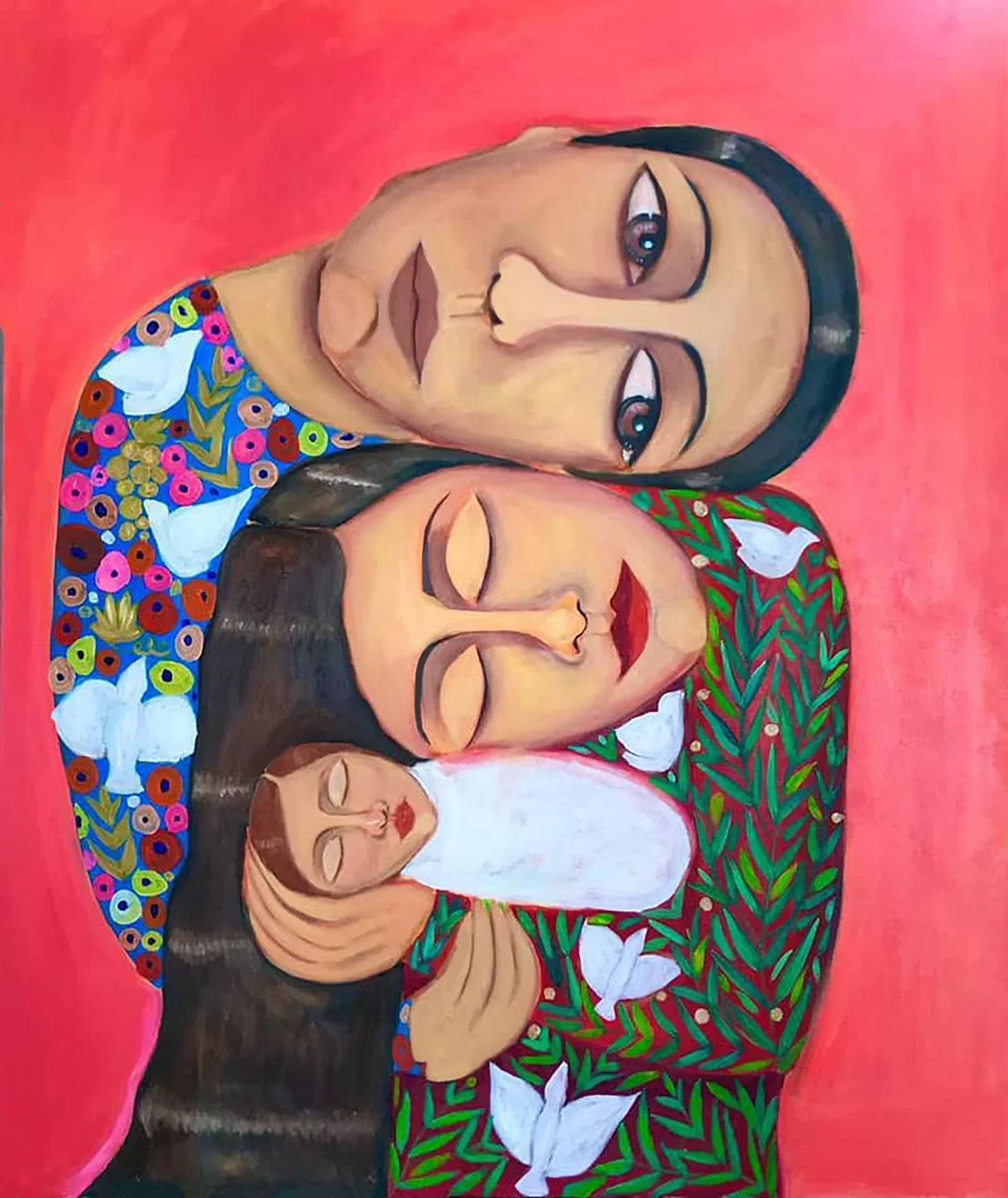
Mother Protecting Her Children, oil on canvas (2021)
Malak Mattar
Over the past few years, temperatures crossed 50°C across multiple countries in the SWANA (Southwest Asia and North Africa) region; it was hot enough to dry up the water sources entire communities depend on. Nearly 3.8 million people were affected by extreme weather events in 2024, in a region that holds 15 of the world’s most water-scarce countries (WMO, 2025). The cruelest part however is that SWANA bears the least responsibility for the emissions driving this climate crisis, and one of the heaviest burdens of its consequences (Faruque et al., 2025). Additionally, the ramifications of climate change do not fall on everyone the same way. Climate change (CC) and gender-based violence (GBV) are two of the most pressing crises of our time, yet they’re rarely discussed together, and almost never through the perspectives of those experiencing both simultaneously. In the SWANA region, this silence raises a fundamental question: whose definitions are we using, and whose realities do they reflect?
“In the SWANA region, this silence raises a fundamental question: whose definitions are we using, and whose realities do they reflect?”
Defining Climate Change and Gender-Based Violence in the SWANA region
Climate change is often described as a global crisis, but in SWANA, it’s already a lived reality. High temperatures are prominent (Lelieveld et al., 2016), droughts are lengthening across North Africa (Waha et al., 2017), and millions depend on agricultural systems already pushed to their limits (Verner, 2012). At its core, climate change refers to long-term shifts in temperature and weather patterns, largely driven by human activity since the industrial era. It affects economic, food and housing security, the availability of water, a range of health conditions, agricultural productivity and natural ecosystems (UNFPA, 2023). In SWANA, those shifts land on already precarious grounds: it is one of the most water-scarce regions on earth due to its naturally arid climate and lack of waterways (Roy et al., 2026 ; Zahrawi, 2017). However, this vulnerability did not emerge from geography alone. For centuries, communities across SWANA sustained themselves through sophisticated customary governance systems: the Hima in West Asia, where tribes communally managed rangelands and water wells to prevent overexploitation (Gari, 2006), and the Agdal in North Africa, which the Amazigh developed as a traditional land management practice that governs access to communal pastoral lands and resources (Cosme et al., 2020). Colonial-era borders dismantled these systems, fragmenting communal territories, severing mutual aid networks, and replacing indigenous resource management with extraction economies imposed from outside (Sultana, 2018). Today, global climate discourse often compounds this history, reducing SWANA to a region defined by what it lacks and positions communities as passive subjects of climate risk rather than actors with their own histories, knowledge, and strategies for responding to environmental change (Sultana, 2018). This framing is never neutral as it shapes where funding flows, which solutions get prioritized, and whose voices are heard in policy rooms.
Defined as harmful acts directed at an individual or group based on their gender, gender-based violence rooted is rooted in systemic gender inequality, the abuse of power, and unequal social norms (UN Women, 2022; Carney, et al., 2020). It encompasses different expressions of violence, including physical, sexual, and emotional violence, by an intimate partner, non-partner violence, such as sexual harrassement, rape, sexual exploitation, human traficking, harmful practices, such as child marriage and female genital mutilation (UNHCR, 2026). Globally, 1 in 3 women experience intimate partner violence or rape from a non-partner in their lifetime, and 1 in 4 women aged 15-24 have already experienced it (WHO, 2024). The consequences extend far beyond the act itself, including injuries, depression, anxiety disorders, unplanned pregnancies, and sexually transmitted infections (ibid.). In SWANA, GBV is often portrayed through a narrow orientalist lens, as a product of “tradition” or culture specific to the region (Al-Ali, 2019). As Abu-Lughod (2013) argues, this perspective obscures women’s agency while also ignoring the political, economic, and social forces that shape their lives. These dynamics become clearer when GBV is situated within the wider conditions that weaken communities, including poverty, conflict, war crimes, occupation, displacement, climate change, and weak institutions (UNFPA, 2023). Conflict and occupation erode social structures, disrupt livelihoods, weaken community protection systems, and intensify household survival pressures. In these contexts, women often carry a disproportionate burden: they are expected to secure their families’ safety, food, shelter, and care, while also taking on expanded unpaid domestic and caregiving labour (UN Women, 2024). These pressures increase women’s exposure to intimate partner violence, exploitation, harassment, trafficking, and other forms of GBV. Importantly, these experiences are not unique to Muslim communities, nor are they a consequence of Islam itself (Moghadem, 2003). Rather, they reflect the broader gendered impacts of war, occupation, displacement, and prolonged instability. In Yemen, years of conflict have driven child marriage adn trafficking to alarming levels as families resort to desperate measures to survive; in Sudan, sexual violence had been deployed as a weapon of war; in Gaza, the destruction of homes and entire communities has exposed women to risks of abuse, exploitation and sexual violence as they’re forced to live in overcrowded living conditions (Femena, 2024). These different drivers accelerate and deepen the inequalities that were already there, stripping women of the economic independence, legal protection, and community networks that might otherwise offer some safety.
The Intersection of CC and GBV in the SWANA region
After defining gender-based violence and climate change, we now examine each issue through an intersectional lens. While both are critical global challenges in their own right, understanding how they interact is even more important, as climate change can intensify existing gender inequalities and increase vulnerabilities to gender-based violence, particularly in fragile and climate-affected contexts (IWMI, 2024).
Emerging evidence demonstrates that climate change acts as a threat multiplier, intensifying pre-existing structural inequalities and discriminatory gender norms. Through pathways such as displacement, livelihood disruption, food insecurity, and resource scarcity, climate-related shocks can heighten vulnerability to various forms of GBV worldwide and gender inequalities, extremism (UNFPA, 2023). Climate change weighs heavily on women and girls in marginalized communities. While deep-seated social norms and systemic inequalities often strip them of economic agency, their limited economic power, coupled with a heavy reliance on climate-sensitive labor, creates significant barriers to effective adaptation and recovery (K.R van Daalen et al, 2022). Climate disasters also trigger a quiet crisis in health and safety. When infrastructure collapses, women and girls lose vital access to healthcare and essential GBV services; just as funding for these lifelines gets diverted to general relief (Thurston et al., 2021).
While western interventions in the SWANA region, and elsewhere, have frequently been justified through the language of human rights, particularly women’s rights. Muslim women have often been portrayed as inherently oppressed solely because of their religion, while the political, economic, and historical realities shaping their lives are overlooked. Rather, displacement, economic collapse, militarization, and state breakdown reshape gender relations, challenging explanations that attribute violence solely to culture or religion. This framing ignores the ways in which foreign intervention, military occupation, and broader geopolitical dynamics have themselves contributed to the conditions of insecurity and hardship experienced by many communities, as seen in contexts such as Iraq, Syria (Rizkalla, et al., 2021) and Sudan (UNHCR, 2024; Alsaba and Kapilashrami, 2016).
The Palestinian community living within the 1948 occupied territories is a clear example of how structural and societal violence can contribute to increasing rates of GBV. This violence damages the social fabric of communities (Abu Nimmer, 2025). Addressing the humiliation and oppression experienced under colonial rule is therefore an important part of addressing domestic violence. Societal violence and GBV do not simply end; they are carried across generations (Al Jazeera, 2025). Areas affected by conflict experience widespread poverty, displacement, and limited access to essential resources, as seen in Palestine, Syria, Lebanon, and Iraq. Prolonged exposure to violence, insecurity, and instability creates a trauma-filled environment in which it is difficult to identify the origins of individual or collective trauma (Amnesty International, 2024). Instead, trauma becomes cumulative and intergenerational, passed down and reinforced through ongoing conflict and structural violence. As Dr. Samah Jabr explains, “The colonial wound (…) psychologically dismantles and disengages Palestinians—it attempts to occupy identity as well. Colonial trauma doesn't only target Palestinians themselves; it also targets relationships between people”.
“The colonial wound (…) psychologically dismantles and disengages Palestinians—it attempts to occupy identity as well. Colonial trauma doesn’t only target Palestinians themselves; it also targets relationships between people.”
Climate change serves as an exacerbating factor across peace, development, and humanitarian aid. It not only triggers new emergencies but destabilizes fragile contexts, exponentially increasing the risk of gender-based violence. Consequently, for women and girls, this instability translates directly into physical danger. As we have seen during the COVID-19 pandemic; risk of GBV exacerbated and affected access to services for survivors (World Bank, 2021 ; ICGBV, 2022).
Conclusion
CC and GBV are thus deeply interlinked and even more so in the SWANA region. As environmental shocks strain already fragile communities, it intensifies pre-existing gendered power imbalances and colonial legacies, and deepens the very inequalities that leave women and girls most exposed. It is critical to investigate the root causes behind why GBV spikes during climate shocks, environmental degradation, and disasters. Understanding this intersection matters precisely because of the dominant narratives, whether they reduce SWANA to scarcity or GBV to “culture”, these accounts obscure the political and structural forces actually driving these outcomes. Addressing the linkage between both crises requires a holistic approach. It’s essential that states and private sector organizations collaborate on establishing a shared understanding of the intersectionality, which will enable cross-sector collaboration to strengthen response mechanisms.
References
Abu-Nimer, M. (2025). Violence and organized crime among Palestinians in Israel: Searching for a savior. Religions, 16(7), 837–837. https://doi.org/10.3390/rel16070837
Abu-Lughod, L. (2013). Do muslim women need saving? In JSTOR. Harvard University Press. https://www.jstor.org/stable/j.ctt6wpmnc
Al Jazeera. (2025). Samah jabr - Palestine in motion. Interactive.Aljazeera.Com. https://interactive.aljazeera.com/aje/2017/palestine-in-motion/jabr.html
Al-Ali, N. (2019). Feminist dilemmas: How to talk about gender-based violence in relation to the middle east? Feminist Review, 122(1), 16–31. https://doi.org/10.1177/0141778919849525
Alsaba, K., & Kapilashrami, A. (2016). Understanding women’s experience of violence and the political economy of gender in conflict: The case of Syria. Reproductive Health Matters, 24(47), 5–17. https://doi.org/10.1016/j.rhm.2016.05.002
Amnesty International. (2024). Understanding the long roots of violence in the occupied palestinian territories and israel. Amnesty International. https://www.amnesty.org/en/latest/education/2024/03/understanding-the-long-roots-of-violence-in-the-occupied-palestinian-territories-and-israel/
Cosme, P. da S., D’Ambrosio, U., Domínguez, P., & M’sou, S. (2020, April 28). What is an agdal? - AMNC. AMNC. https://www.mednatureculture.org/what-is-an-agdal/
Faruque, M. O., McKie, R. E., Christel, L. G., Debucquois, C., Edwards, G., Gellert, P. K., Gutierrez, R. A., Hochstetler, K., Li, Y., Milani, C. R. S., Möhle, E., Oguntuase, O. J., & Walz, J. R. (2025). Climate obstruction across the global south. Climate Obstruction, 212–240. https://doi.org/10.1093/oso/9780197787144.003.0008
Femena. (2024). The war on women in conflict zones - femena, rights peace inclusion. Femena, Rights Peace Inclusion -. https://femena.net/2024/11/25/the-war-on-women-in-conflict-zones/
Gari, L. (2006). A history of the hima conservation system. Environment and History, 12(2), 213–228. https://doi.org/10.3197/096734006776680236
Irish Consortium on Gender Based Violence. (2022). Gender based violence and its intersection with climate change. https://www.gbv.ie/wp-content/uploads/2022/03/ICGBV-Policy-Paper-Climate-Change-and-GBV.pdf
IWMI. (2024). Gender-based violence prevention as a climate adaptation imperative. International Water Management Institute (IWMI). https://www.iwmi.org/blogs/gender-based-violence-prevention-as-a-climate-adaptation-imperative
Lelieveld, J., Proestos, Y., Hadjinicolaou, P., Tanarhte, M., Tyrlis, E., & Zittis, G. (2016). Strongly increasing heat extremes in the middle east and north africa (MENA) in the 21st century. Climatic Change, 137(1–2), 245–260. https://doi.org/10.1007/s10584-016-1665-6
Moghadam, V. M. (2003). Modernizing women: gender and social change in the middle east. https://www.rienner.com/uploads/47d98be66a50c.pdf
Rizkalla, N., Adi, S., Mallat, N. K., Soudi, L., Arafa, R., & Segal, S. P. (2021). Manzuaat wa musharadat, uprooted and scattered: Refugee women escape journey and the longing to return to syria. Frontiers in Psychology, 12, 537131. https://doi.org/10.3389/fpsyg.2021.537131
Roy, D., Klobucista, C., & Robinson, K. (2021, April 22). Water stress: A global problem that’s getting worse | council on foreign relations. Cfr.Org. https://www.cfr.org/backgrounders/water-stress-global-problem-thats-getting-worse
Sultana, F. (2022). The unbearable heaviness of climate coloniality. Political Geography, 99(99), 102638. https://doi.org/10.1016/j.polgeo.2022.102638
Thurston, A. M., Stöckl, H., & Ranganathan, M. (2021). Natural hazards, disasters and violence against women and girls: A global mixed-methods systematic review. BMJ Global Health, 6(4), e004377. https://doi.org/10.1136/bmjgh-2020-004377
UN Women. (2022). Tackling violence against women and girls in the context of climate change [Review of Tackling violence against women and girls in the context of climate change]. UN Women – Headquarters. https://www.unwomen.org/en/digital-library/publications/2022/03/tackling-violence-against-women-and-girls-in-the-context-of-climate-change
UN Women. (2024). Gender alert: The gendered impact of the crisis in gaza. UN Women – Headquarters. https://www.unwomen.org/en/digital-library/publications/2024/01/gender-alert-the-gendered-impact-of-the-crisis-in-gaza
UNFPA. (2023a). Gender-based violence in the context of climate change in the arab region 2023: review of evidence and pathways. https://arabstates.unfpa.org/sites/default/files/pub-pdf/gbv_in_the_context_of_climate_change_14.pdf
UNFPA. (2023b). The need for integrated climate change action in sexual and reproductive health and gender-based violence programming: Evidence and recommendations for the arab region. UNFPA Arab States. https://arabstates.unfpa.org/en/publications/need-integrated-climate-change-action-sexual-and-reproductive-health-and-gender-based
UNHCR. (2025a). Gender-based violence. Unhcr UK. https://www.unhcr.org/uk/what-we-do/safeguard-human-rights/protection/gender-based-violence
UNHCR. (2025b). Sudanese refugee women defy odds to rebuild their lives in chad | UNHCR. Unhcr. https://www.unhcr.org/news/stories/sudanese-refugee-women-defy-odds-rebuild-their-lives-chad
Van Daalen, K. R., Kallesøe, S. S., Davey, F., Dada, S., Jung, L., Singh, L., Issa, R., Emilian, C. A., Kuhn, I., Keygnaert, I., & Nilsson, M. (2022). Extreme events and gender-based violence: A mixed-methods systematic review. The Lancet Planetary Health, 6(6), e504–e523. https://doi.org/10.1016/s2542-5196(22)00088-2
Vener, D. (2012). Adaptation to a changing climate in the arab countries: A case for adaptation governance and leadership in building climate resilience. The World Bank. https://documents1.worldbank.org/curated/en/740351468299700935/pdf/Adaptation-to-a-changing-climate-in-the-Arab-countries-a-case-for-adaptation-governance-and-leadership-in-building-climate-resilience.pdf
Waha, K., Krummenauer, L., Adams, S., Aich, V., Baarsch, F., Coumou, D., Fader, M., Hoff, H., Jobbins, G., Marcus, R., Mengel, M., Otto, I. M., Perrette, M., Rocha, M., Robinson, A., & Schleussner, C.-F. (2017). Climate change impacts in the Middle East and Northern Africa (MENA) region and their implications for vulnerable population groups. Regional Environmental Change, 17(6), 1623–1638. https://doi.org/10.1007/s10113-017-1144-2
Wen, J. (2020). Gender-based violence and environment linkages. Munchen. https://munch.tind.io/record/44896
WMO. (2025). Temperature increase is accelerating in the Arab region, with escalating impacts. World Meteorological Organization. https://wmo.int/news/media-centre/temperature-increase-accelerating-arab-region-escalating-impacts
World Bank Group. (2025). Regional action plan to address gender-based violence in the middle east and north africa region. World Bank; World Bank Group. https://www.worldbank.org/en/region/mena/publication/regional-action-plan-to-address-gender-based-violence-in-the-middle-east-and-north-africa-region
World Health Organization. (2024, March 25). Violence against women. World Health Organization. https://www.who.int/news-room/fact-sheets/detail/violence-against-women
Zawahri , N. A. (2017). Water security in the middle east and north africa - franklin humanities institute. Franklin Humanities Institute. https://humanitiesfutures.org/papers/water-security-middle-east-north-africa/index.html
