
Displaced by War, Forgotten by Climate: Refugee Girls and the Right to Education in SWANA
Editor’s Note: While this contribution exceeds our standard word limit, the editorial team has retained its full length to preserve the nuance, context, and integrity of the analysis.
My name is Thalia Kattoura, a Lebanese feminist organizer and researcher working at the intersection of secular politics, gender justice, and the rights of marginalized communities. At Climate Sirens, I serve as Research Director within the Policy Committee. Having witnessed racist campaigns and institutional barriers targeting refugees since childhood, I came to understand the cost of excluding them —especially refugee girls— from justice in Lebanon. Seeing blame repeatedly shifted onto systematically excluded communities, rather than Lebanon’s political and financial elites, pushed me to amplify the stories of refugees who continue to bear the consequences of failed policies in Lebanon and the wider region.
My name is Aya Aboseada, a humanitarian professional working with refugee and displaced children of mixed nationalities in Egypt, and a Policy Committee Member at Climate Sirens. Writing about refugee girls and climate justice grew from what I witness in work that sits at the intersection of child protection, displacement, and psychosocial wellbeing — the weight that displaced girls carry, the barriers that appear ordinary but are structurally designed, and the resilience that too often goes unacknowledged. I wrote this piece because the girls I work with deserve to be at the center of the conversations being had about their futures — not as case studies, but as the reason these conversations must change.
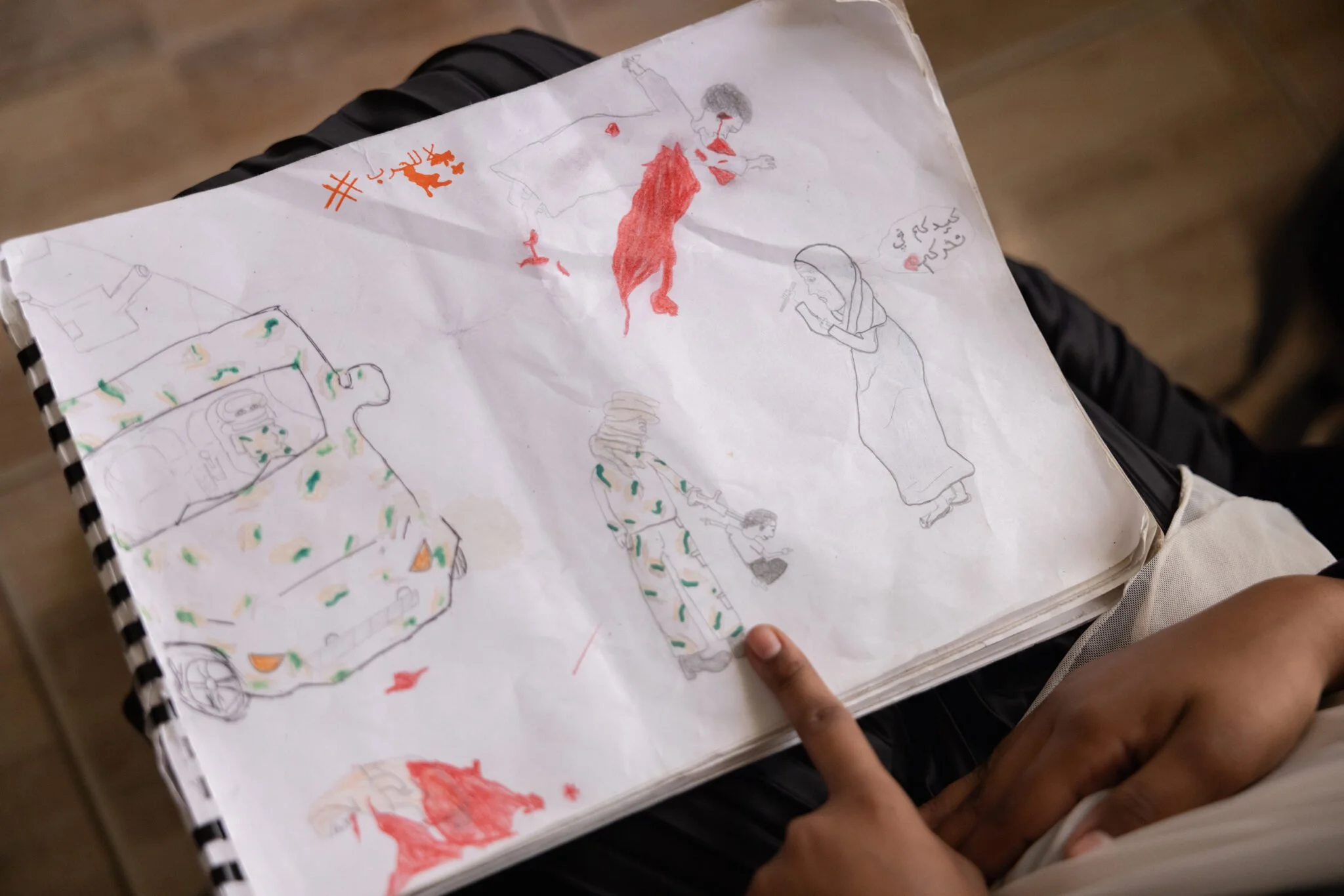
Sudanese student Aseel shares her searing sketch of Sudan’s living nightmare in between her classes at the Dreams Community Center for Education.
Cairo, Egypt — June 13, 2024 — Walaa Alshaer
In Cairo, Aseel, a 14-year-old Sudanese girl, sits in a classroom she almost never reached. She fled Khartoum in June 2023, moving through RSF-controlled streets, hearing every day of people she knew being killed, kidnapped, or raped. “I was very scared,” she later said, “because we know what they [soldiers] do to girls.” (Alshaer & Kurancid, The Nation, 2024) She made it. Many did not — not to safety, and not to school.
She is not an exception. She is the rule.
Across the SWANA region, millions of girls have been displaced by war, only to find themselves displaced a second time — from classrooms, from futures, from the conversations that are supposed to be about them. And layered beneath the violence that forced them to move is a crisis that rarely makes the headlines: climate change. Rising temperatures, water scarcity, and food insecurity are quietly reshaping what is possible for displaced households — and it is girls who absorb the cost first.
This article focuses on two countries: Egypt, home to refugees from Sudan, Syria, Eritrea, Palestine, and beyond, navigating an economic crisis and a rapidly changing climate; and Lebanon, home to Syrian and Palestinian refugees who have long navigated both political collapse and environmental crisis. Together, they tell a story that neither can tell alone: climate justice in the SWANA region will remain incomplete for as long as it fails to center the girls it is leaving behind.
“Climate justice in the SWANA region will remain incomplete for as long as it fails to center the girls it is leaving behind.”
Setting the Scene: Refugees Amidst a Climate Crisis
The scale of displacement in the SWANA region is staggering. Egypt currently hosts over 1.5 million refugees and asylum seekers from Sudan, Syria, Eritrea, South Sudan, Palestine, and other countries across the region (EU ECHO, 2026). The conflict in Sudan alone, which erupted in April 2023, displaced more than 12 million people — making it the largest displacement crisis in the world — with Egypt receiving the highest number of those who crossed borders (Refugees International, 2025). Sudanese make up 75% of Egypt’s registered refugee population, and 76% of newly registered refugees from Sudan are women and children (EU ECHO, 2026). Since October 2023, over 130,000 people — including around 30,000 children — have fled Gaza to Egypt, adding yet another layer to an already overstretched system (EU ECHO, 2026). Lebanon, meanwhile, holds the world’s highest per-capita refugee population, with approximately 1.5 million Syrian refugees and 210,000 Palestinian refugees, the latter confined to camps since the 1948 Nakba.
Both countries sit within a region the scientific community consistently identifies as one of the world’s most severe climate hotspots. SWANA is warming at roughly twice the global average rate, with extreme heat events becoming more frequent and intense. In Egypt, the country is approaching critical levels of extreme water scarcity — defined as 500 cubic meters per person per year — projected as early as 2033, while the agricultural sector risks losing up to half its productivity by 2060 (Atlantic Council, 2024;Hamzawy et al., 2023). In Lebanon, public water supplies fell from an average of 120 liters per capita per day to below 35 liters since 2019, and over 70% of the population now faces critical water shortages (MEI, 2023). The Bekaa Valley, where the largest concentration of Syrian refugees in Lebanon live, is projected to face a 20% decrease in annual rainfall and significant groundwater depletion (Climate Centre, 2024). Desertification is an expanding pressure across the broader region, with land degradation and drought accelerating the loss of arable land that displaced communities depend on.
What connects these contexts is the concept of “host country burden”: the disproportionate weight that lower-income host countries carry in sheltering the world’s displaced populations, with limited international support. In both Egypt and Lebanon, this burden has become largely invisible in humanitarian frameworks — as have the specific ways it lands on girls. The 2024 Sudan Regional Refugee Response Plan called for $109 million to address refugee education needs across the region; by mid-2024, only 20% of that amount had been mobilized (ECW, UNHCR & UNICEF, 2024).
Egypt and Lebanon illuminate the same problem from different angles. What makes them comparable is not their political or institutional similarity, but the shared reality they produce: in both countries, the interaction between climate stress, economic precarity, and displacement is pushing girls out of education in ways that existing frameworks have largely failed to name, let alone address.
Climate Stressors and Household Survival
Climate change does not arrive in a refugee household as an abstract threat. It arrives as a water bill that cannot be paid, as a midday heat that makes a 40-minute walk to school physically dangerous, as a harvest that failed and a rent that did not. For displaced families in Egypt and Lebanon — already stripped of savings, legal status, and community networks — climate stressors function as one more lever that tips households into crisis, and it is girls who are first asked to absorb that crisis.
Extreme heat, water scarcity, and food insecurity compound each other in documented ways. In Lebanon’s Bekaa Valley, when summer temperatures exceeded 42°C in informal tented settlements, MSF recorded that respiratory infections accounted for around 42% of clinic visits during the summer (MSF, 2015). In Egypt, 58% of refugees are food insecure (EU ECHO, 2026), pushed further by inflation averaging 16% in 2025 and climate-related disruptions to regional agriculture. In both contexts, schooling becomes among the first sacrifices — not as a household failure, but as a predictable outcome of a system that leaves no other option. Female-headed households lose 8% more income due to heat stress than male-headed ones (UNICEF, 2024), compounding a pattern of gendered economic vulnerability that runs across both countries.
Early marriage is another well-documented response to economic crisis in displacement contexts. When families face destitution, marriage is often perceived as a form of financial stability and protection for girls — a calculation that reflects the absence of any other option. Climate stress does not cause this calculation — but it accelerates it. When food prices rise and incomes shrink, the timeline between economic crisis and that decision shortens. Research consistently shows that school dropout and early marriage reinforce each other: girls out of school are more vulnerable to marriage pressure, and girls who marry almost always leave school. In conflict and displacement settings, protection from sexual violence is frequently cited as an additional driver, as girls who are out of school face heightened risk of exploitation.
The route to school is itself a barrier. Displacement concentrates refugees in informal urban settlements in Cairo and in tented settlements in the Bekaa where safe, affordable transport is scarce. Sudanese women in Cairo described to researchers constant street harassment and the impossibility of reporting it without risking deportation (Refugees International, 2025). For families weighing the cost of transport against the risk of assault, keeping a daughter home is the only decision the system has made available to them.
These dynamics are not separate from climate change. They are its downstream consequences in contexts of displacement, poverty, and gender inequality. Climate stress does not act alone — it amplifies existing vulnerabilities, and in Egypt and Lebanon’s refugee communities, those vulnerabilities are heavily gendered.
Refugee Girls' Educational Context in Egypt
Egypt has long been a major host country for refugees from across the region — Syrians who arrived in large numbers after 2011, Eritreans and South Sudanese fleeing persecution and conflict, Palestinians who have been making their way through the Rafah crossing since October 2023, and over a million Sudanese displaced by the war that began in April 2023. This diversity matters: each nationality navigates a different legal status, a different language barrier, and a different relationship with Egyptian institutions. What they share is this: they are all navigating a system that was not built for them, in a country facing its own compounding crises (HRW, 2024).
The scale of displacement since April 2023 has been transformative. The registered Sudanese refugee population grew almost sevenfold in under two years, and Egypt now hosts more Sudanese refugees than any other country (ECW, UNHCR & UNICEF, 2024). Of newly registered refugees from Sudan, 76% are women and children (EU ECHO, 2026). They arrive carrying the particular weight of what women and girls experience in conflict: many fled sexual violence, witnessed atrocities, and traveled through transit routes where protection was unavailable. As one Sudanese woman told Refugees International: “If I told you stories of rape in Sudan, you would be shocked. You wouldn’t even be able to believe them” (Refugees International, 2025).
They arrive into a country already under severe climate and economic stress. Egypt’s economic crisis — marked by inflation averaging 16% in 2025, currency devaluation, and rising food prices — has deepened poverty for both host communities and refugees. An assessment by WFP and UNHCR found that 56% of refugees in Egypt cannot afford basic needs, 65% are highly or extremely vulnerable, and 58% are food insecure (EU ECHO, 2026). Climate change compounds this: summer temperatures are breaking records, and coastal flooding threatens Alexandria and the Nile Delta. For families spending most of their income on rent and food, any additional pressure can be the margin that determines whether a child stays in school. As Egypt's economic crisis continues to erode household incomes, compounded by climate-driven rises in food prices and summer temperatures that disrupt livelihoods, the cost of navigating bureaucratic alternatives moves further out of reach.
The barriers to education in Egypt are formidable and interlocking. Egypt requires proof of residency to enroll in public schools — a document most refugee families cannot obtain (HRW, 2024). As of 2024, wait times for asylum-based residency stood at over two years, with new appointments being issued only from September 2027 onward (Refugees International, 2025). NGO staff estimate that only about 7,000 Sudanese children are enrolled in Egyptian public schools out of at least 300,000 school-aged Sudanese children registered with UNHCR (Refugees International, 2025) — and this does not account for the tens of thousands of Syrian, Eritrean, South Sudanese, and Palestinian children facing the same barriers. Approximately 54% of newly arrived children are currently out of school (ECW, UNHCR & UNICEF, 2024). The alternative — private or community schools — charges fees that most families cannot sustain, and the certificates issued are not recognized by Egypt’s Ministry of Education (HRW, 2024).
Palestinian children from Gaza face a particularly acute version of this exclusion. Over 100,000 Palestinians have crossed into Egypt since October 2023, and the vast majority have not been able to secure legal residency or enroll in public schools (HRW, 2024). On paper, Palestinians are entitled to residency and employment under the 1967 Casablanca Protocol, signed by Egypt and other Arab nations. In reality, these provisions are largely ignored (New Internationalist, 2025). As one displaced Palestinian mother told Refugees International: “For me, this is another form of displacement. People are escaping death. They had some money to pay to leave, but when they arrived here, they faced the challenge of restarting their lives” (Refugees International, 2024). Her children, like tens of thousands of others, cannot attend Egyptian schools, and 75% of Palestinian households in Egypt have no income (EU ECHO, 2026), making private education an impossibility.
In June 2024, Egyptian authorities closed at least 50 Sudanese community schools citing lack of registration and licensing (Refugees International, 2025), erasing one of the few functioning education pathways. A 16-year-old Sudanese girl told Refugees International: “In the past, I was a good student, getting good grades… but now two years without any education, no teacher to help me.” Even those fortunate enough to access a school often drop out due to harassment and bullying — particularly children of Sub-Saharan African origin, who face additional layers of racism and stigma.
Early marriage and domestic labor fill the gaps that education leaves behind. UNHCR’s 2024 Annual Results Report documented that 86% of GBV survivors assisted in Egypt were women, and 19% were children — with Sudanese survivors comprising 68% of all reported cases (UNHCR Egypt, 2025). Syrian, Eritrean, South Sudanese, and Palestinian women and girls face similar risks, often with even less visibility in the humanitarian response.
What is missing is not documentation of the problem. It is action at the intersection. Psychosocial support programs, safe space initiatives, and community-based education exist and are doing vital work. But they operate in a context where structural conditions — lack of legal status, unaffordable housing, climate-worsened economic precarity, and a bureaucratic system that treats refugees as burdens rather than rights-holders — continue to push girls out faster than programs can bring them in.
Refugee Girls' Educational Context in Lebanon
In Lebanon, environmental crises, institutional exclusion, and recurring war shape everyday life across the country. For Syrian and Palestinian refugee girls, these forces intersect with the gendered realities of refugee status, further constraining their access to education.
Although the Lebanese public education system is theoretically open to refugee children, it remains exclusionary in practice because of underinvested infrastructure and the multitude of barriers that refugees face (Human Rights Watch, 2016). Many refugee children are unable to access public schooling because of stringent and expensive paperwork requirements, overcrowding of public schools, and economic precarity.
When it comes to Palestinian refugees, the Lebanese state has banned them from 39 professions and from property ownership. Because the majority cannot enter or are not sufficiently supported by the public system, Palestinian children are educated almost entirely through UNRWA's parallel network of 65 schools serving 39,144 students (Shuayb, 2014; UNRWA, n.d.). Most Syrian refugee children who do access public education, meanwhile, attend separate afternoon or "second shifts," introduced by the state to ease the overcrowding problem in Lebanese public schools (Shuayb et al., 2014).
These restrictions are further compounded by Lebanon's nationality law, which prevents Lebanese women from passing their nationality to their children, leaving some children of Palestinian or Syrian fathers stateless or without legal documentation.
On top of the existing institutional and social discrimination against refugees, Palestinian and Syrian refugee girls have to confront violence that is reinforced by gendered roles and climate risks. In fact, these girls' absence or dropout from an already fragile schooling system correlates closely with child marriage: 19% of Palestinian girls in Lebanon marry before the age of 18, rising to 25% among Palestinian refugees displaced from Syria (UNICEF, 2017). Especially when Palestinians face constant barriers to their future professional life, girls' futures are the first the household writes off.
For those who remain in education, access remains plagued by unsafety, no sense of belonging, and unequal opportunities. Palestinian and Syrian refugee girls reported multiple forms of harassment, ranging from bullying based on their nationality to wider patterns of bias and prejudice. For Syrian girls in particular, attending separate afternoon-shift schools reinforced feelings of inferiority and marked them as distinct from their Lebanese counterparts (Al Masri & Abla, 2015). Violence and harassment by teachers and school staff further undermined schools as spaces of protection for refugee girls (Human Rights Watch, 2019).
Climate stress reaches girls' education firstly through the household. Around 900,000 Syrian refugees live in informal tented settlements concentrated in the Bekaa Valley. These settlements are characterized by harsh weather conditions in both winter and summer; Médecins Sans Frontières recorded summer temperatures reaching 42°C, with respiratory infections accounting for around 42% of clinic visits during the summer (Médecins Sans Frontières, 2015). However, climate stress often reaches girls' education through a "quieter" mechanism. A 2018 World Vision study in Bekaa found that when water supply was halved, 46% of households would take on more debt, a third would accept low-paid work, and 5% of families would send their children to work (Breidy, 2018). Evidently, schooling becomes among the first sacrifices; this is not a household "failure" or "coping mechanism" but a predictable outcome of a system that leaves no other option.
When it comes to Palestinian refugee camps, UNRWA's funding cuts and lack of flexibility for rehabilitation of camps because of Lebanese government decisions have exacerbated these camps' water crisis. In February 2026, the Al Murshid well in Ein El Hilweh cut operating hours to 3 hours a day after UNRWA had to reduce its diesel distribution, causing a severe water crisis (The New Arab, 2026). Water shortages have shown to deepen period poverty, a documented driver of school absence among refugee girls in Lebanon.
The war on Lebanon in 2024, that continued later into 2026, compounded every pressure.
In October 2024, roughly 500 of Lebanon's 1,126 public schools were converted into shelters, and nearly 60 per cent of all shelters nationwide were located in schools (Save the Children, 2024; UNICEF, 2024). UNRWA temporarily suspended most of its operations in Tyre due to their own staff being displaced, effectively preventing Palestinian children in Rashidieh, El Buss, and Burj Shemali from accessing their parallel school system (UNRWA, 2024).
The Israeli bombardment that has yet again expanded in 2026 displaced over 1.2 million people, among them 500,000 school-aged children; with more schools converted to shelters (UNESCO, 2026).
Beyond mass re-displacement and its disruption on education, women and girls themselves reported feeling unsafe, where gender-based violence and exploitation were occurring in supposed "safe" school centers. UNFPA documented intimate partner violence, sexual violence, exploitation and harassment across the 669 collective centers (UNFPA, 2026). Refugees were often unable to even access these shelters, discriminated against for their identity. Instead, they were left in unfinished buildings, vehicles, and open public spaces, exposed at once to cold, to damaged water infrastructure, and to food prices the war had pushed further out of reach (Médecins Sans Frontières, 2026; Access Center for Human Rights, 2026). The war therefore displaced refugees into conditions already exacerbated by Lebanon’s climate crisis: drought and declining water availability placed additional pressure on damaged water systems, while climate-related losses in agricultural production reinforced the war’s effects on food availability and prices. The conclusion we keep circling back to: refugee girls sit yet again at the intersection of climate vulnerability, exclusion, racism, and patriarchy — with no other choice but to absorb every layer of this violent war.
Toward Climate Justice that Includes Refugee Women and Girls
Climate justice is often framed in the language of emissions, transitions, and global agreements. But for a displaced 14-year-old girl in Cairo or a Syrian teenager in the Bekaa Valley, climate justice looks like this: a school close enough to reach safely, a family secure enough that her education is not the first thing to go, a future that has not already been decided by forces she had no part in creating.
Refugee girls must therefore be included in climate policy rather than treated as an afterthought. Centering them in regional climate responses requires more than abstract solutions to systems that already exclude them. It means confronting the legal, political, and economic conditions that make refugee girls be the first to absorb the effects of climate stress, war, and crisis (UNHCR, 2022; UNICEF & Karama, 2023). In fact, protecting refugee education from funding cuts, abrupt school closures, segregation and violence, and unsupported parallel systems must be tackled as part of climate resilience rather than as a separate apolitical, humanitarian concern (UNESCO, 2019). It is important to acknowledge that these measures will not remove the wider barriers facing refugee families, but they will help shift responsibility away from girls and toward the institutions that produce and sustain their exclusion.
Conclusion
The question is not simply whether refugee girls can enter a classroom, but whether they can pursue a future that is not taken away from them. In Egypt and Lebanon, too many girls are asked to carry the consequences of decisions made by governments, donors, institutions, and foreign powers: cuts to education, exclusionary laws, unsafe schools, failing infrastructure, and policy responses that bury their stories.
Climate justice must therefore be seen through the lens of intersectionality. A response that speaks of resilience while excluding refugee girls from the framework is not a holistic response. Refugee girls are not just recipients of aid, they are changemakers whose knowledge and experiences should shape the policies made in their name. The 14-year-old girl in Cairo should not have to suffer to reach her classroom. The girl living in a tent in the Bekaa should not have to be scared of what will happen when she is at school. The education of refugee girls should not be an exceptional practice, it should be the standard.
References
Access Center for Human Rights. (2026, May 31). Statement 4: Syrian refugees remain acutely vulnerable in times of crisis. https://achrights.org/en/2026/05/31/16426/
Al Masri, M., & Abla, Z. (2015). Better together: The impact of the schooling system of Lebanese and Syrian displaced pupils on social stability. International Alert. https://www.international-alert.org/app/uploads/2015/12/Lebanon_LebaneseSyrianSchoolingSystem_EN_2015.pdf
Breidy, J. (2018). Assessment of reduction of water provision in informal tented settlements and its association with the livelihood status of Syrian refugees in the Bekaa Valley. World Vision International.
Human Rights Watch. (2016). "Growing up without an education": Barriers to education for Syrian refugee children in Lebanon. https://www.hrw.org/report/2016/07/19/growing-without-education/barriers-education-syrian-refugee-children-lebanon
Human Rights Watch. (2019). "I don't want my child to be beaten": Corporal punishment in Lebanon's schools. https://www.hrw.org/report/2019/05/13/i-dont-want-my-child-be-beaten/corporal-punishment-lebanons-schools
Médecins Sans Frontières. (2015, August 20). Lebanon: Heat wave adds to the woes of Syrian refugees in Bekaa Valley. https://www.msf.org/lebanon-heat-wave-adds-woes-syrian-refugees-bekaa-valley
Médecins Sans Frontières. (2026, March 7). Lebanon: MSF scales up response as displacement rises across the country. https://msf.org.au/article/project-news/lebanon-msf-scales-response-displacement-rises-across-country
The New Arab. (2026, February 13). Severe water crisis hits two Palestinian camps in Lebanon. https://www.newarab.com/news/severe-water-crisis-hits-two-palestinian-camps-lebanon
Save the Children. (2024). Education disrupted for sixth year for 1.5 million children in Lebanon, with half of public schools used as shelters. https://reliefweb.int/report/lebanon/education-disrupted-sixth-year-15-million-children-lebanon-half-public-schools-used-shelters
Shuayb, M. (2014). The art of inclusive exclusions: Educating the Palestinian refugee students in Lebanon. Refugee Survey Quarterly, 33(2), 20–37. https://doi.org/10.1093/rsq/hdu002
Shuayb, M., Makkouk, N., & Tuttunji, S. (2014). Widening access to quality education for Syrian refugees: The role of private and NGO sectors in Lebanon. Centre for Lebanese Studies. https://lebanesestudies.com/wp-content/uploads/2014/09/Widening-Access-to-Quality-Education-for-Syrian-Refugees-the-role-private-and-NGO-sectors-in-Lebanon-.pdf
United Nations Children's Fund. (2017). Child marriage in the Middle East and North Africa: Lebanon country brief. UNICEF Middle East and North Africa Regional Office; International Center for Research on Women. https://www.unicef.org/mena/media/1806/file/MENA-CMReport-LebanonBrief.pdf
United Nations Children's Fund. (2024). UNICEF Lebanon humanitarian situation report no. 4 (23 September – 22 October 2024). https://reliefweb.int/report/lebanon/unicef-lebanon-humanitarian-situation-report-no-4-23-september-22-october-2024
United Nations Children's Fund & Karama. (2023). Climate change: Impact on adolescent girls [Advocacy brief]. UNICEF Middle East and North Africa Regional Office. https://www.unicef.org/mena/media/23806/file/Climate%20Change%20Impact%20on%20Adolescent%20Girls%20-%20Advocacy%20Brief%20.pdf
United Nations Educational, Scientific and Cultural Organization. (2019). Global education monitoring report 2019: Migration, displacement and education – Building bridges, not walls. https://unesdoc.unesco.org/ark:/48223/pf0000366946
United Nations Educational, Scientific and Cultural Organization. (2026, April 9). In Lebanon, UNESCO allocates $650,000 to support the continuity of education for displaced populations.https://www.unesco.org/en/articles/liban-lunesco-renforce-ses-operations-durgence-pour-la-scolarisation-des-populations-deplacees
United Nations High Commissioner for Refugees. (2022). All inclusive: The campaign for refugee education. https://reliefweb.int/report/world/unhcr-education-report-2022-all-inclusive-campaign-refugee-education
United Nations Population Fund. (2026). UNFPA situation report: Lebanon, 26 March – 1 April 2026. https://www.unfpa.org/resources/unfpa-situation-report-lebanon-26-march-%E2%80%93-1-april-2026
United Nations Relief and Works Agency for Palestine Refugees in the Near East. (2014). Harmonized results report 2014. https://www.unrwa.org/sites/default/files/harmonized_results_report_2014_0.pdf
United Nations Relief and Works Agency for Palestine Refugees in the Near East. (2024, October 11). UNRWA situation report #6 on the Lebanon emergency response (7–10 October 2024). https://www.unrwa.org/resources/reports/unrwa-situation-report-6-lebanon-emergency-response
United Nations Relief and Works Agency for Palestine Refugees in the Near East. (n.d.). Education in Lebanon. Retrieved July 31, 2026, from https://www.unrwa.org/activity/education-lebanon
Alshaer, W., & Kurancid, E. (2024, August 29). Displaced from Sudan, young refugees find solace at school. The Nation. https://www.thenation.com/article/world/sudanese-displacement-egypt/
Atlantic Council. (2024). Climate profile: Egypt. https://www.atlanticcouncil.org/programs/middle-east-programs/rafik-hariri-center-for-the-middle-east/mena-futures-lab/macromena/climate-profile-egypt/
Hamzawy, A., Al-Mailam, M., & Arkeh, J. (2023, October 26). Climate change in Egypt: Opportunities and obstacles. Carnegie Endowment for International Peace. https://carnegieendowment.org/research/2023/10/climate-change-in-egypt-opportunities-and-obstacles
Climate Centre / RCCC. (2024). Country profile: Lebanon. https://www.climatecentre.org/wp-content/uploads/RCCC-ICRC-Country-profiles-Lebanon.pdf
Education Cannot Wait, UNHCR, & UNICEF. (2024, August 22). Sudan regional refugee crisis: Education Cannot Wait, UNHCR, UNICEF and strategic partners call for increased resources. https://www.educationcannotwait.org/news-stories/press-releases/sudan-regional-refugee-crisis-education-cannot-wait-unhcr-unicef-and
European Commission – DG ECHO. (2026). Egypt country page. EU Civil Protection and Humanitarian Aid. https://civil-protection-humanitarian-aid.ec.europa.eu/where/middle-east-and-northern-africa/egypt_en
Human Rights Watch. (2024, December 2). Egypt: Education restricted for refugees. https://hrw.org/news/2024/12/02/egypt-education-restricted-refugees
Médecins Sans Frontières. (2015, August 20). Lebanon: Heat wave adds to the woes of Syrian refugees in Bekaa Valley. https://www.msf.org/lebanon-heat-wave-adds-woes-syrian-refugees-bekaa-valley
Middle East Institute. (2023). Amid Lebanon's perfect storm of crises, water demands attention. https://mei.edu/publication/amid-lebanons-perfect-storm-crises-water-demands-attention/
New Internationalist. (2025). No status, no school: Palestinian children in Egypt. https://newint.org/education/2025/no-status-no-school-palestinian-children-egypt
Refugees International. (2024). It's time to help Palestinians left behind in Egypt. https://www.refugeesinternational.org/perspectives-and-commentaries/its-time-to-help-palestinians-left-behind-in-egypt/
Refugees International. (2025, February 21). No model of refuge: Sudanese refugees in Egypt. https://www.refugeesinternational.org/reports-briefs/no-model-of-refuge-sudanese-refugees-in-egypt/
UNHCR Egypt. (2025). Annual results report 2024. https://www.unhcr.org/sites/default/files/2025-06/egypt_arr_2024.pdf
United Nations Children's Fund. (2024). Tackling gender inequality in a climate-changed world. https://www.unicef.org/blog/tackling-gender-inequality-climate-changed-world
